A 12-year-old cat is roughly 64 in human years.
The conversion is not seven-to-one and never was. Cats do most of their maturing in the first two years, then age at a steady, slower rate.
The table
| Cat age | Human equivalent | Life stage |
|---|---|---|
| 1 year | 15 | Junior |
| 2 years | 24 | Junior |
| 3 years | 28 | Prime |
| 4 years | 32 | Prime |
| 5 years | 36 | Prime |
| 6 years | 40 | Prime |
| 7 years | 44 | Mature |
| 8 years | 48 | Mature |
| 10 years | 56 | Mature |
| 12 years | 64 | Senior |
| 14 years | 72 | Senior |
| 15 years | 76 | Senior |
| 16 years | 80 | Super-senior |
| 18 years | 88 | Super-senior |
| 20 years | 96 | Super-senior |
The rule behind every row:
Year 1        = 15 human years
Year 2        = +9   (total 24)
Every year after = +4
So twelve years is 24 + (10 × 4) = 64.
Why the first two years are worth so much
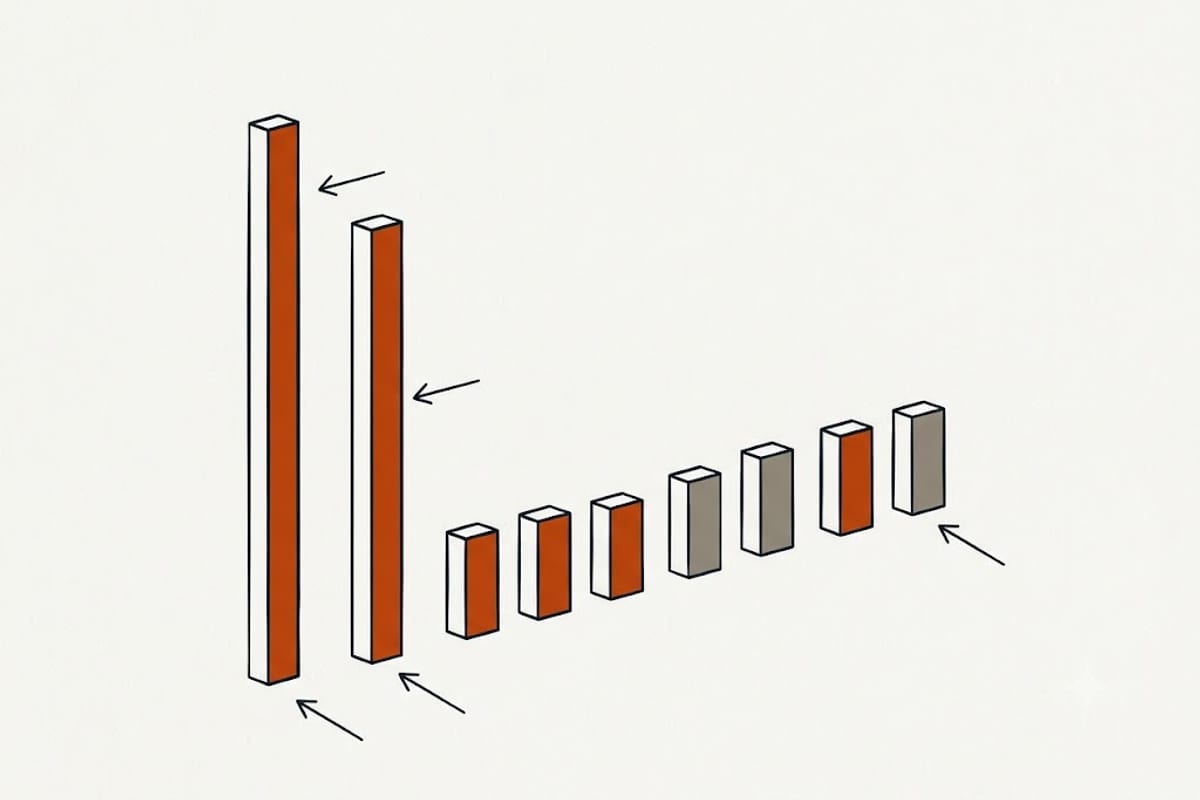
A one-year-old cat is sexually mature, fully grown in frame, and socially adult. A one-year-old human is none of those things. The fifteen-year figure is an attempt to say that a cat has completed adolescence in twelve months.
The second year finishes the filling-out — muscle, final skull shape, adult behaviour settling — which is worth roughly nine more human years and lands a two-year-old cat at a human twenty-four.
After that, both species are simply adults getting older, and the four-to-one ratio holds remarkably steadily until the very end of life.
The stage names matter more than the number
Veterinary practice uses life stages rather than the human conversion, because the stage is what changes the care:
Junior (up to 2) — growth, vaccination schedule, neutering.
Prime (3–6) — the healthiest window. Annual checks, weight watched.
Mature (7–10) — the human forties and fifties. This is when bloodwork starts being worth doing as a baseline rather than as a response to a problem.
Senior (11–14) — kidney values, thyroid, blood pressure and dental disease all become likely enough to screen for. Twice-yearly checks are standard advice.
Super-senior (15+) — the same, more often, with weight tracked closely.
A 12-year-old cat sits at the start of senior, and that is the practical content of "64": an age at which screening finds things early rather than late.
Indoor and outdoor are two different species, statistically
Indoor cats commonly live 12 to 18 years, with twenty not unusual. Outdoor and indoor-outdoor cats average dramatically less — often cited at 5 to 7 years — and the difference is almost entirely traffic, predators, fights and infectious disease rather than any biological ageing difference.
Breed shifts it a little. Siamese and Burmese lines are often long-lived; some large breeds such as Maine Coons average slightly shorter. Neutered cats live longer than intact ones of the same sex.
What ageing actually looks like
Sleeping more is not a reliable sign — adult cats already sleep 12 to 16 hours. More telling: reluctance to jump to places they used to reach, weight loss despite a normal or increased appetite, drinking noticeably more, a coat that looks unkempt because grooming has become uncomfortable, and litter box changes.
Weight loss with a good appetite in a cat over ten is the classic presentation of hyperthyroidism or early kidney disease, and both are far more manageable caught early. It is the single most useful thing to watch for at 64.
Dogs age on a completely different schedule that depends on adult size — a subject with its own weight tables — and any weight-based dose changes as a senior animal loses condition.